

The New Hampshire Uniform Commercial Code registry is maintained by the Secretary of State and functions as the state’s central record of security interests in personal property. When a lender advances funds against equipment, inventory, receivables, or titled vehicles, a filing in this index establishes a priority position that continues even if the borrower later defaults, sells the business, or restructures.
The same database also carries federal tax liens, state tax liens, aircraft registration liens, and writs of attachment, so one name query can reveal obligations that never surfaced on a credit report. Interpreting those results requires attention to filing dates, collateral language, lapse dates, and the identity of the party holding the interest.
What the New Hampshire UCC Index Actually Contains
The index is a notice system rather than a title register. It holds financing statements, amendments, continuations, assignments, terminations, and information statements, together with the statutory liens that the same office records. Each entry names a debtor, a secured party, a collateral description, and the dates that decide how long the notice lasts.
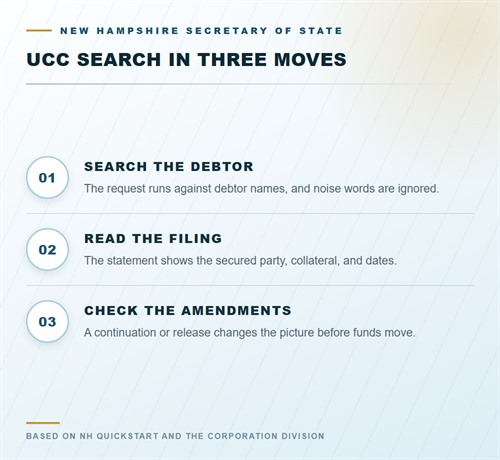
Which Filings Perfect an Interest
Perfection happens when a security interest attaches and a financing statement reaches the filing office with the required information. Attachment requires value given, a debtor with rights in the collateral, and a security agreement. Filing supplies the public notice that lets a creditor defeat a later claimant or a trustee in bankruptcy. No filing means no priority against most third parties.
Records That Remain Searchable
Lapsed statements, terminated filings, and assignments all stay visible in the historical record, and each carries its own status marker. A terminated filing is not a live claim, but its presence proves that a relationship once existed. Distinguishing live from dead records is the first task in reading any response.
New Hampshire UCC forms and search requests:
https://www.sos.nh.gov/ucc-and-statutory-liens/ucc-forms-and-search-requests
Tax Liens and Writs That Share the Same Registry
Statutory liens are recorded in the same system as commercial statements, which is why a single response can include an Internal Revenue Service lien, a state tax lien, an aircraft registration lien, or a writ of attachment from pending litigation. Each type follows its own release procedure and duration, and each deserves separate treatment in credit analysis rather than being merged with ordinary collateral claims.
Federal Tax Lien Entries
An IRS lien appears under the taxpayer’s name and shows the assessment amount, the filing date, and the office of record. It attaches to property and rights to property belonging to the taxpayer, which can reach assets a commercial creditor believed it had locked down. Priority between the federal lien and a UCC filing turns on timing and on perfection status.
State Tax and Attachment Records
New Hampshire revenue liens and writs of attachment use similar naming conventions, and both can complicate a closing. A writ signals litigation that may end in a judgment lien against real or personal property. Counsel usually orders copies of these entries and confirms current status with the agency before releasing funds.
How Debtor Names Drive Every Search
Requests run against debtor names only, and the system ignores noise words, so articles and corporate suffixes such as “the,” “and,” or “inc” style terms carry no weight in matching. That convention helps when a filer recorded a name slightly differently from the organizer’s version, but it also widens any result set. Begin with the exact legal name on the formation document.
Variants Worth Requesting
After the legal name, request reasonable alternatives: a former name used before a merger, a trade name printed on invoices, initials in place of given names, and hyphenated or spaced versions of a surname. Each variation is a separate request with its own charge, so rank them by likelihood of appearing in lending paperwork. Individual debtors need the most care.
Individual Versus Organization Debtors
For sole proprietors and individual guarantors, search the person’s name and any registered trade name the business uses. An organization is searched under its exact registered designation, punctuation and suffix included. Where a filing predates a conversion between entity types, the earlier designation may still hold the record, so check LLC records for prior names.
The Three UCC-11 Search Request Levels
New Hampshire issues results at three service levels, and the selection affects turnaround as much as substance. A routine request is worked in the order received. A 24-hour request moves ahead in the queue. A same-day request receives urgent handling, which suits closings with fixed funding dates. All three return the same underlying information about matching filings.
Choosing a Level for a Closing
Diligence that begins weeks before a closing fits a routine request comfortably. When a commitment letter, a title company, or a disbursement schedule sets a hard deadline, the faster levels exist for exactly that situation. Treat the higher charge as a transaction cost rather than an avoidable expense, and order early enough to leave room for follow-up.
What the Response Includes
Each response identifies the debtor searched, the scope of the query, the date and time of the run, and the filings that matched. It also states the filing office’s certification status. Results reflect the index at the moment of the run rather than the moment of delivery, which is why the interval before funding deserves attention.
Repeat Pulls Before Disbursement
Any gap between the initial pull and the wire is a window for new filings. A seller can pledge the same equipment to a second lender, a judgment creditor can record a lien, or a competing bank can perfect against receivables. A refreshed request costs little relative to the exposure it closes off.
Fees for Filings, Searches, and Expedited Handling
The schedule below reflects current Secretary of State charges. Walk-in expedited amounts are added to the filing fee rather than substituted for it. Online payments also carry a statutory handling charge, so a filer paying electronically should plan for a slightly higher total. Paper submissions and portal submissions share the same base rates for every form.
| Item | Paper | Online |
|---|---|---|
| UCC-1 financing statement (up to two debtors, one addendum page) | $48 | $48 |
| Each additional page attached | $35 | $35 |
| Each additional debtor or secured party name beyond two | $40 | $40 |
| UCC-3 amendment, continuation, partial release, assignment, or termination | $48 | $48 |
| UCC-5 information statement | $48 | $48 |
| Public finance transaction filing | $96 | $96 |
| Manufactured housing filing | $96 | $96 |
| Transmitting utility filing | $96 | $96 |
| EFS-1 or EFS-3 | $15 | $15 |
| UCC-11 search, routine | $10 | $10 |
| UCC-11 search, 24-hour | $25 | $25 |
| UCC-11 search, same day | $35 | $35 |
| Walk-in expedited filing, same day (added to filing fee) | $50 | — |
| Walk-in expedited filing, 24 hours (added to filing fee) | $25 | — |
| Online payment handling (RSA 5:10-a) | — | $2.00 |
How the Page and Name Charges Compound
The base financing statement covers two debtors and one addendum page. A filing with four debtor names and three attached pages therefore costs the base rate plus two name charges and two page charges. Filers who submit long collateral schedules should total these components before quoting a cost to a client or a borrower.
Charges for Specialized Collateral
Public finance transactions, manufactured housing, and transmitting utility filings sit at a higher flat rate because each involves statutory variations in duration or recording practice. A manufactured housing filing covers a home treated as personal property. Transmitting utilities file once and remain effective far longer than the standard five-year cycle.
Filing Through NH QuickStart
The state portal at quickstart.sos.nh.gov presents UCC filing and UCC search as distinct login options, and one session does not cover both functions. A filer creates an account, completes the form in the browser, attaches addendum pages, and pays electronically. The portal returns an acknowledgment showing a file number and timestamp, which is the evidence that perfection occurred that day.
Accounts and Authorized Users
Filing accounts tie to a user identity, and organizations that file in volume register a designated representative. Credentials deserve control because an accepted submission binds the secured party of record. Keep the acknowledgment page in the loan file next to the signed security agreement so timing can be proven later without reconstructing it.
Paper Submissions When the Portal Is Unavailable
Paper forms remain acceptable and are delivered to the Secretary of State with the appropriate fee. Counter service offers expedited handling at an added charge. A paper submission returns a file-stamped copy as proof, and that stamp carries the same evidentiary weight as an electronic acknowledgment when a dispute over dates arises.
Reading a Financing Statement Line by Line
Every record identifies the debtor, the secured party, and the collateral, together with the filing date, file number, and lapse date. The collateral description does the real work: a narrow phrase naming one specific item limits the claim, while broad language covering a category reaches much further. The secured party’s address shows where assignments should be directed.
Debtor and Secured Party Fields
Compare the debtor field against the name on the borrower’s organizational documents. Small differences in punctuation or suffix can matter against a competing creditor. The secured party field identifies the original lender, and a later assignment entry reveals the current holder, which is the party to approach for a payoff figure or a release.
Dates, File Numbers, and Lapse
The filing date fixes priority order among competing interests. The file number is the reference used for amendments, continuations, and copy requests. The lapse date shows when the statement expires without action. Recording all three in a diligence summary lets a reviewer compare filings chronologically and spot breaks in an otherwise continuous chain.
Addenda and Attached Pages
Long collateral schedules and multiple debtors appear on addendum pages that form part of the record. Review the attachments, not only the first page, because a limitation buried in an addendum can narrow the grant substantially. Filers pay an added charge for each extra page beyond the allowance included with the base fee.
Collateral Descriptions That Change the Answer
Practitioners read for whether the description reaches inventory, equipment, accounts, chattel paper, instruments, or general intangibles, and whether proceeds language appears. A filing naming only equipment leaves receivables open for another creditor. Where a business pledges substantially everything, a broad reference should prompt a request for the underlying security agreement to see the actual grant.
Inventory and Accounts
Inventory financing covers goods held for sale or lease, and accounts covers rights to payment for goods or services delivered. Both categories fluctuate, which is why lenders monitor borrowing bases and borrowing base certificates. A filing reaching these categories can capture receivables a later creditor expected to fund, and priority follows the earlier perfection date.
Equipment and Specific Goods
Equipment filings often describe serial-numbered items or a class of machinery. A specific description makes release easier when individual units are sold, while a class description catches replacements. Either approach must identify the collateral adequately, and vague wording invites dispute over what was actually pledged when a dispute arrives.
Proceeds and After-Acquired Property
A grant covering proceeds continues the interest into whatever replaces the original collateral, including insurance payments and sale receipts. After-acquired property clauses extend coverage to assets the debtor obtains later. Both features expand a creditor’s reach well beyond the items present on the closing date, which affects how a competing lender sizes its own exposure.
Amendments, Continuations, and Terminations
A financing statement lapses five years after filing unless the secured party records a continuation, and a lapsed statement generally loses priority. Amendments correct debtor names or collateral language, assignments move the interest to a new holder, partial releases narrow the claim, and terminations remove the record entirely. Repeat the search shortly before funding because these changes arrive without warning.
Timing Rules for Continuations
A continuation must be filed within the six months before expiration. Filing earlier has no effect, and filing after the lapse date leaves the original statement dead, requiring a fresh financing statement that ranks from its own date. Calendaring that window is one of the more consequential administrative duties a secured party carries.
Terminations and Payoff Mechanics
When a loan is repaid, the secured party of record files a termination so the record stops appearing as a live encumbrance. Buyers and lenders routinely condition closing on delivery of that filing. Verify the termination in the index rather than trusting a promise letter, because the record is what third parties will see.
Name Changes After a Merger
A debtor that changes its name through merger or conversion can lose perfection within a short statutory window unless an amendment is filed. The four-month rule after a name change is easy to miss in busy operations. Diligence should compare the current registered name against the name on every open financing statement.
Why a Lender Cares About the Result
A prior filing against the same collateral usually places the new lender behind the earlier creditor, which changes advance rates or ends the transaction. Clean results allow funding to proceed. Results showing an existing interest may lead to a payoff and termination, a subordination agreement, or a decision to decline. Vehicle and aircraft title work follows parallel logic through separate systems.
Priority and the First-to-File Rule
Among competing perfected interests in the same collateral, the earlier filing generally wins. That makes the timestamp on a financing statement the most important data point in a priority contest. A lender that funds before perfecting can lose to a creditor who files moments later but records first in the same index.
Subordination and Intercreditor Arrangements
When two lenders both hold interests, a subordination agreement reorders them by contract rather than by filing date. The senior creditor agrees to limit its claim, and the junior party gains a defined position it can price. These arrangements belong in the loan file and should be read alongside the index results.
When the Result Points to Fraud
A filing by an unfamiliar party against a borrower with no corresponding loan can indicate identity theft or a bogus recording. Debtors can pursue removal of a fraudulent statement, and lenders should flag the entry rather than ignore it. Unusual secured party addresses or obviously mismatched collateral descriptions justify a closer look.
Obtaining Copies and Certified Results
Responses list matching filings, and copies of individual statements are available on request. A certified search carries the Secretary of State’s authentication and is what counsel typically attaches to a closing opinion or a loan file. Uncertified results serve preliminary diligence and internal credit review. Ordering copies together with the search avoids a second round of correspondence.
What Certification Adds
Certification confirms that the listed filings were on record as of the stated time and that the copy is a true reproduction. It gives a relying party comfort that nothing was omitted through clerical error. Some lenders require certified output above an internal threshold, so confirm the expectation before the closing date arrives.
Retention and Refresh of Diligence
Store results with the run date visible, and refresh them close to disbursement. An older report describes what existed weeks earlier, not what exists today. Examination practices and loan covenants often specify how recent a pull must be, so match the refresh interval to the policy governing the file.
Frequently Asked Questions
Questions about this registry usually concern scope, naming, timing, and charges. The answers below address points that arise repeatedly when a business, a lender, or counsel pulls entries from the Secretary of State’s index and must act on business records that sit alongside them.
Is the UCC registry the same as the business entity database?
No. The UCC registry holds security interests and statutory liens, while the entity database holds formation records for corporations, limited liability companies, and other organizations. Both sit with the Secretary of State, and thorough diligence checks each one separately.
Can I search by collateral instead of a debtor name?
Lookup runs by debtor name, so collateral-first searching is not offered as a standard service. Identify the party, then review collateral descriptions in the returned filings. Vehicle and aircraft interests may be traceable through separate registration systems.
How long does a financing statement remain effective?
Five years from the filing date unless a continuation is recorded within the six months before expiration. A transmitting utility filing lasts considerably longer. After a lapse, the interest typically becomes unperfected and later creditors can move ahead.
What separates the three search service levels?
Routine requests are processed in order, 24-hour requests move ahead in the queue, and same-day requests receive urgent handling. Charges differ by level, and the table above lists each amount. The substance of the response is identical across all three.
Do federal tax liens appear in the results?
Yes. The index also holds federal and state tax liens, aircraft registration liens, and attachment writs. Each one affects priority, so a lender clears them with the filing office before funds move.
Who files a UCC-3 termination?
The secured party of record normally files it once the obligation is satisfied, which releases the collateral from the recorded claim. A debtor cannot unilaterally remove a filing, though statutory remedies exist when a creditor refuses after full payment.