

Choosing a name for a New Hampshire business raises two separate questions. First, is the designation already claimed by another registrant? Second, does it satisfy the statutory rules attached to the entity class you intend to form? Both can be settled before anyone signs a formation document or pays a filing charge.
The Corporation Division applies both tests when a name arrives. Staff compare the proposed name against the register for distinguishability, then check the required ending and any restricted vocabulary. A designation may pass one test and fail the other, so checking both early spares a refiling and the delay that follows it.
Where New Hampshire business names are recorded
Legal names, trade names, and reserved names all sit in the Corporation Division’s register, which the public reaches through the state’s NH QuickStart portal. The file reaches back through dissolved and revoked companies, not only current ones. A designation that looks free may belong to a business that stopped reporting years ago yet still holds its place. A reader who needs the company behind a name can follow the New Hampshire LLC records page.
What the register contains
Each entry carries a name, a business ID, a class label, and a status. Trade names sit beside limited liability companies and corporations rather than in a separate file, so one search covers both kinds of claim. Reserved names appear as well, which matters because a reservation blocks a later formation even though no entity exists yet.
Reading a result row
A row shows the registered spelling, the class, and whether the registration stands active. Spelling matters more than it appears: a plural ending or a hyphen can separate two unrelated businesses, and the register preserves whatever was filed. Copy the name exactly when quoting it in a contract, a lease, or a bank application.
New Hampshire trade name rules and Form TN-1:
https://www.sos.nh.gov/corporations-0
The distinguishability comparison
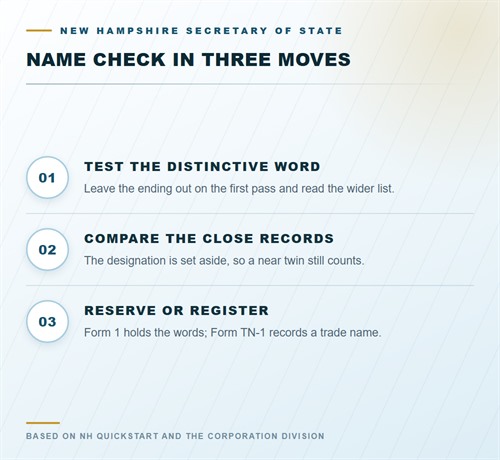
Division staff compare a proposed name against existing entries to decide whether the public can tell the two apart. The inquiry looks past punctuation, spacing, and predictable swaps. A designation differing only by an ampersand, a plural ending, or a leading article usually fails, since a reader scanning the register would treat the pair as one business.
Substitutions that fail
Swapping company for co., group for associates, or a numeral for its spelled form rarely creates distance. Neither does adding a generic industry word to an otherwise identical name. Reviewers weigh the impression the whole name makes when read in passing on a printed list, not the count of characters that differ between the filings.
Distinctive terms that succeed
A genuinely different distinctive element usually survives review. Two names may share a generic trade word while a coined term at the front gives each its own identity. Words describing the service itself carry little weight, so a new designation should lean on something invented, geographic, or personal rather than plainly descriptive.
Required endings by entity class
A limited liability company must carry Limited Liability Company, Limited Liability Co., L.L.C., or LLC somewhere in its name. A corporation carries Corporation, Incorporated, Company, Limited, Corp., Inc., or Co., with comparable abbreviations accepted. The ending tells anyone reading the register that owners hold limited liability for the obligations of the business.
Professional and nonprofit classes
Professional entities add their own designations and often restrict who may hold an ownership stake. Nonprofits use corporation or incorporated but cannot adopt the limited liability company ending. Each class files its own formation document, and each travels a slightly different review path inside the Division’s office.
Restricted words and consent
Words such as bank, trust, and insurer signal regulated activity. Using one generally requires written consent from the supervising agency before the Division accepts the papers. The consent travels with the formation document, and a submission missing it stalls at intake until the missing approval arrives from the agency that issued it.
Reserving a name on Form 1
A reservation holds a designation for a set period while organizers prepare their filing. Form 1 stands as an optional document, filed separately from the formation papers rather than at the same moment. An investment trust pays a higher amount than other organizers, and the online channel adds a handling charge on top of the statutory figure.
Who cannot reserve
Form 1 cannot be filed for a nonprofit corporation or for a trade name. Those applicants move straight to their own registration instead of holding a designation in advance. The Division returns a reservation submitted for either category, so organizers should confirm their class before reaching for that particular form.
How the holding period runs
The reservation protects the name against later filings for its statutory term, then lapses unless the entity has formed. Organizers who miss the window may find the designation claimed by someone else in the meantime. Reserving close to the formation date, rather than months ahead, keeps the calendar simple to track.
Trade names and Form TN-1
A trade name is required whenever a person conducts business under a designation other than their own legal name. A sole proprietor operating as a named shop needs one, and so does a company marketing under a brand distinct from its registered legal name. Form TN-1 records the designation and returns a certificate confirming the filing.
Renewal and information changes
A trade name registration runs for a fixed term and must be renewed to stay in force, with renewal carrying the same charge as the original filing. Correcting details on an existing registration costs nothing to submit, which makes address updates painless. Abandoning the designation requires a separate discontinuance form rather than simple inaction.
Partnership additions and withdrawals
Partnerships record membership changes through dedicated forms, one for an addition and one for a withdrawal. Each carries its own charge, and both keep the underlying trade name intact while the roster shifts. Online submission adds the handling charge that applies to other electronic filings handled by the Division.
Why a proposed name is refused
Refusal traces to a handful of causes: a designation indistinguishable from an existing entry, a missing required ending for the class, or a restricted word submitted without consent. Occasionally a name suggests a governmental connection or a purpose the entity cannot lawfully pursue. The Division returns the papers with the specific ground identified in writing.
Grounds stated on the return
The return letter names the reason rather than leaving organizers to guess. Where indistinguishability is at issue, the letter identifies the conflicting registration so the overlap can be examined directly. Where consent was missing, the letter says which approval the file lacked, and the cure is usually a single added document.
Refiling after refusal
A revised name can be submitted once the ground is addressed, and a fresh inquiry confirms whether the replacement clears the register before the papers go back. Organizers sometimes keep the distinctive element and change only the ending, which fails again when the conflict sits in the distinctive portion rather than the suffix.
Names implying a state connection
A designation suggesting a department, a board, or an official body draws scrutiny even when no restricted word appears in it. Reviewers ask whether the public could believe the entity acts on behalf of the state. Organizers steer away from titles, bureau, and commission unless they genuinely hold the authority those words convey.
Fees for name filings
Amounts below show the counter price beside the online total, which includes the handling charge assessed on electronic payment. Trade name filings follow their own schedule, separate from formation charges. Certified copies add a per-page amount to the base figure, while expedited handling is a flat addition available on either channel.
| Item | Paper | Online |
|---|---|---|
| Name reservation, Form 1 | $15 | $17 |
| Name reservation, NH investment trust | $30 | $32 |
| Trade name, Form TN-1 | $50 | $52 |
| Trade name renewal | $50 | $52 |
| Trade name discontinuance, TN-9 | $10 | $12 |
| Partnership addition, TN-5 | $10 | $12 |
| Partnership withdrawal, TN-7 | $10 | $12 |
| Trade name information change | $0 | $2 |
| Certificate of good standing | $5 | $7 |
| Certified copy | $5 plus $1 per page | $7 plus $1 per page |
Where the handling charge comes from
Electronic payment triggers a handling charge set by statute rather than by the portal. It applies per transaction, so grouping several name filings into one checkout trims the total drawn from the account. Paper submissions at the Concord counter avoid the charge but lose the immediate acknowledgment that an online submission generates.
Expedited service
Expedited handling moves a request ahead of routine work for a flat addition to the charge. It suits a closing date or a bank deadline rather than everyday filings. The option works for name documents and for certificates alike, and it changes only queue position, never the substance of what the office records.
Documents that confirm a registered name
Banks, landlords, and licensing agencies frequently want proof of the name as the state holds it. Two documents serve that purpose. A certificate of good standing states the registered name and confirms that reports and charges are current. A certified copy reproduces a filed document with the Division’s authentication stamped on it.
Ordering a good standing certificate
The certificate reflects the record when the request is processed, so an overdue annual report blocks a clean result. Clearing the delinquency first avoids a wasted order. The document states the entity name, its business ID, and its standing, which satisfies most account openings and lease applications presented by small businesses.
Certified copies for outside agencies
A certified copy bills a base amount plus a per-page figure, so a lengthy agreement costs more than a one-page certificate. Out-of-state agencies often require this version rather than a plain photocopy. Expedited processing shortens the wait when a deadline is already tight and the counter queue looks long.
What a certificate does not prove
A good standing certificate speaks only to the Division’s own file. It says nothing about tax standing, occupational licensing, or a lawsuit pending in another courthouse. Lenders sometimes read the document as a broader clearance than it is, so review the wording before promising a counterparty that the certificate settles every question about the business.
Searching variations before committing
Run several queries instead of one. Try the distinctive word alone with a contains match, then the full proposed name with exact match. Check singular and plural forms, and check the ending you plan to use. Cross-referencing business records and agent details often reveals a cluster of companies sharing one address.
Shared agents as a clue
When unrelated-looking names share a registered agent or a principal office, they frequently belong to one ownership group. That pattern matters during a name check, since a related company may hold a designation the organizers assumed was abandoned. Inspecting the cluster before filing prevents a surprise refusal at the intake window.
Prior designations and name history
Existing records sometimes list earlier names adopted before an amendment. Those former designations can still sit in the register or in the memory of local customers. Reviewing the filing sequence shows which spellings a competitor has already used, narrowing the field of workable options for a new venture.
Names held by inactive entities
A dissolved company’s name remains in the register and continues to block a new registration until the record is cleared. Occupancy matters more than activity in this comparison. Before concluding that a designation is free because the prior holder stopped reporting, confirm the current status and the date of the last filing on that record.
Status before availability
Status labels distinguish active registrations from those dissolved, revoked, or merged away. A revoked entity may still hold its name if nobody has filed to release it. Reading the label first saves an organizer from building a brand around a designation the office will refuse to record.
Reuse after dissolution
Names do return to circulation once a record closes, though the timing depends on how the prior entity ended. An organizer who wants a dormant designation may wait for the release or choose a variant that clears the comparison. Confirming with the Division before printing materials avoids a costly rebrand after launch.
Timing and processing in Concord
Name filings move through the Corporation Division at 25 Capitol Street in Concord. Counter submissions and mailed submissions follow one review sequence, and expedited service is available for an added charge. Online filings arrive at once but still wait for staff review before the name is recorded in the register as official.
Counter versus online submission
Walking papers into the Concord office lets a filer ask questions at the window and leave with a receipt in hand. The online route removes travel and produces an immediate acknowledgment, though it adds the handling charge. Neither path skips review, and both end with the same recorded entry.
What review covers
Review confirms the ending, tests the designation against existing entries, and checks any consent letter for restricted vocabulary. Staff also look for a name implying a purpose the entity cannot pursue. A filing that passes each of these is recorded with a date that anchors later renewals and annual obligations.
Preparing papers for review
Bundle the formation document, the consent letter where one applies, and the payment before submitting anything. A complete package clears intake on the first attempt, while a missing attachment restarts the clock and pushes the recorded date back. Keep a copy of everything sent, since the acknowledgment references the day the office received it. The corporation records page follows the same name rules for a charter.
Frequently Asked Questions
Organizers ask a predictable set of questions before filing name papers, and most of them turn on availability, endings, and the reservation form. The answers below cover the points that arise most often when a designation is checked for the first time, including what happens after a refusal.
Must I reserve a name before forming a company?
No. Reservation is optional and simply protects a designation while the formation papers are prepared. Form 1 is filed separately, not with the formation document, and the hold lapses after its statutory term when no entity forms.
How does the office judge two names too close?
Reviewers compare the names as a whole, setting aside punctuation, spacing, and trivial substitutions. When an ordinary reader would treat both as the same business, the Division finds them indistinguishable and refuses the later submission.
What ending does a limited liability company need?
An LLC needs one of the recognized LLC endings, and a corporation needs one of the corporate endings, placed inside the registered string.
When is a trade name registration necessary?
When the sign differs from the owner legal name, Form TN-1 records the brand. A proprietor with a shop name and a company with a separate brand both file it.
Can a nonprofit or a trade name be reserved?
Neither can be reserved on Form 1. Nonprofit corporations and trade names are excluded from the reservation process, so those applicants proceed directly to their formation or trade name filing instead of holding a designation in advance.
What can I do when a name is refused?
Address the ground stated in the return. Supply the missing consent, add the required ending, or choose a designation that clears the comparison, then confirm availability through the inquiry before resubmitting the papers to the Division.