

A New Hampshire limited liability company starts life as one document filed with the Secretary of State’s Corporation Division at 25 Capitol Street in Concord, and every paper the state later holds about that business hangs from the same file. The certificate names the company, its registered agent, and the person who signed it, and it fixes the date from which the entity exists in law.
The sections below follow that file through its whole life: the certificate itself, the members and managers the state declines to publish, the report due each April, the amendments that alter the terms, the papers that move an agent or close the company, and the standing of an out-of-state LLC that registers to trade here. Each part names the form the office expects.
The Limited Liability Company File in New Hampshire
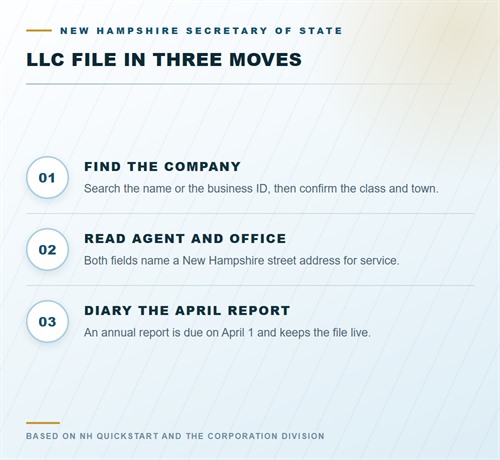
A New Hampshire LLC search returns one entry per company, keyed to a business ID that the division issues when the certificate is accepted. The entry carries the legal name, the town of the registered office, the standing, and a list of every document processed against the file since formation. Nothing on the page describes what the business does or earns.
What the File Holds and What It Omits
The file holds formation papers, amendments, restatements, agent appointments, annual reports, merger records, and a cancellation where one was filed. It omits the operating agreement, the member list, the accounts, the staff, and any licence the trade requires. The division is a filing office, not a regulator of the trade itself.
How the Entry Is Indexed
The index sorts on the legal name exactly as the certificate spelled it, and the business ID sits underneath as the stable key. A reader who knows neither can search the surname of an organiser or the town in the office field. Once a match appears, the type and the standing beside it confirm that the right file has been opened.
New Hampshire LLC forms and fees:
https://www.sos.nh.gov/corporations-0/forms-and-fees/limited-liability-companies
The Certificate of Formation and Form LLC-1
Form LLC-1 creates the company, and the division accepts it through QuickStart or on paper. The certificate gives the name, the registered agent and office, a mailing address, the purpose, and the name and address of the organiser. A company that intends to practise a regulated profession files PLLC-1 instead, on much the same terms.
Terms Set in the Certificate
The certificate states whether the company is member-managed or manager-managed, and that choice decides who may act for the business. A member-managed LLC leaves decisions with the owners, while a manager-managed one hands them to named managers or to a class of them. The division records the choice without judging how it is used.
Professional Companies Under PLLC-1
A professional limited liability company is formed for a service the state licenses, such as law, medicine, accounting, or engineering. Form PLLC-1 asks for the same particulars as LLC-1 and adds the professional purpose, and the owners must be licensed in that field. One member who loses a licence can affect the standing of the whole company.
Name Rules Read at the Counter
A New Hampshire LLC must carry Limited Liability Company, L.L.C., or LLC at the end of its legal name, and the name must differ from every live entry in the register. Words that suggest a bank, an insurer, or a licensed trade need approval from the agency that governs them. The division checks the string before accepting the paper.
Members and Managers in the Public Record
Ownership of an LLC stays private in New Hampshire. The register does not list members, their interests, or a manager’s name unless that manager also serves as the registered agent. A reader who needs the owners must ask the company, read a contract, or check a lien or court file where a name was disclosed under oath.
Why the Register Stays Silent on Owners
The certificate is a public document and the operating agreement is not, so the governance terms sit in a private paper. An owner who wants privacy relies on that split, while a counterparty who wants certainty asks for a signed statement instead of a search result. Neither route proves that the business is solvent.
Reading a Manager-Managed Entry
Where the certificate names managers, the entry may show a title beside an address, and that is as close as the public record comes to an officer list. The label describes authority rather than ownership, and a manager may hold no interest in the company at all. Treat the field as a contact point for service.
What a Buyer Can Ask For
A purchaser of an LLC usually wants the operating agreement, a member resolution approving the sale, and a statement that no lien sits against the interests. None of those papers come from the division. A search confirms that the company exists and stands in order, and the rest comes from the seller.
The Annual Report Due on April 1
Every LLC files an annual report on or before April 1, and the report keeps the registration alive. It restates the accepting party, the street office, and the postal point, so a notice reaches someone who reads it. A report that arrives late is assessed a late charge on top of the standard amount.
Filing Through QuickStart
The report is filed in the QuickStart account that holds the company, at quickstart.sos.nh.gov/online/Account/LandingPage, and the portal issues a confirmation carrying the date. A company that relocated mid-cycle should update the office and the accepting party on the form, because mail sent to a vacated address reaches nobody. The confirmation is the proof of filing.
What the Report Asks For
The form carries the business ID, the legal name, the agent and office, the principal office, and the name of the signer. A company that has changed its agent should file Form 10 rather than wait for the report, because the report confirms an appointment instead of creating one. The two papers can travel together.
After a Late or Missing Report
A missed deadline brings a late charge and, after a longer silence, an administrative cancellation of the registration. A company restored afterwards keeps the gap in its document list, and a lender reading that list sees both the lapse and the return. Restoration is a separate filing from the report itself.
Amendments and Restatements
A change to the certificate is made on Form LLC-3, and the amendment replaces the term it names while leaving the rest of the document as filed. A restatement rewrites the whole certificate and takes the place of everything before it. Either paper appears in the document list with its own date.
What an Amendment Usually Alters
The usual subjects are the company name, the registered agent, the registered office, and the management structure. A name change also needs a check that the new string is free in the register, because two live companies cannot hold the same legal name. The amendment then carries the name exactly as it will be indexed.
Restatement and Its Uses
A restated certificate is useful once several amendments have made the original hard to follow, and it gives a bank or a purchaser one clean text. A correction, by contrast, fixes a clerical fault in a paper already accepted. Both produce a new entry, and neither backdates the original filing.
Timing and Effect
An amendment takes effect when the division accepts it, and the register then shows the new term from that date. Work done under the earlier certificate stays valid, since the change alters the terms going forward. A counterparty checking an old contract should match it against the filing date before raising a question.
Changing the Registered Office or Agent
Form 10 records a new registered agent, a new registered office, or both, and the agent must sign to accept the appointment. The office and the agent belong to one appointment, so a move within Concord needs the form even when the agent stays. The address must be a street address in New Hampshire, never a post box.
Commercial Agents and Individual Agents
A company may appoint a commercial registered agent holding many appointments, or an individual such as an owner or a lawyer. A commercial agent is easier to keep current when the company moves, while an individual agent costs nothing but leaves the file exposed if that person relocates. Either way the name is public.
The Agent’s Consent
The form carries the agent’s signature, and the division rejects a paper without it. A company that names an agent who has not agreed loses time, because the appointment is not effective until the consent is on file. A commercial agent signs in advance for each client it accepts.
Effect of a Lapse in Appointment
An agent who resigns leaves the company without a valid appointment until a replacement is filed, and a summons delivered in the interval may reach nobody. The register shows the appointment as filed, not as intended, so a reader should check the date on the latest Form 10 before sending a notice.
Mergers and Conversions
A merger combines two or more companies into one survivor, and the survivor holds the assets and duties of the others. The filing is short, but the plan behind it is not, since the members of each company must approve on the terms in their own operating agreements. The register records only the survivor.
Papers for a Merger
The division expects articles of merger signed by each company, and the survivor’s file carries the entry while the others are marked as merged. A creditor who dealt with a company that disappeared into a merger should look to the survivor for payment. The document list keeps that chain intact.
Conversion to Another Form
A conversion turns an LLC into a corporation, or brings a corporation into the LLC form, without dissolving the enterprise. The filing carries the name before and after, and the assets stay with the same business through the change. A lender should note the new type on any security document.
Records After a Merger
The surviving company holds the records of the companies it absorbed, and a creditor or a former member should address a request to the survivor. The division keeps the merged entry as a closed file rather than deleting it. A search on the old name still returns the entry with the merger noted.
Cancelling the Registration
A company that has finished its work files a certificate of cancellation on Form LLC-7, and the division removes it from the active list. The paper confirms that debts are paid or provided for and that the remaining assets have gone to the members. A cancellation filed early can leave creditors without a route to the owners.
Voluntary and Administrative Closure
A voluntary cancellation comes from the company, and an administrative one comes from the division after a lapse in reporting. The two carry different labels, and a reader quoting the register should give the exact one. A company closed by the office may still hold assets a member can recover.
Reinstatement After Closure
Reinstatement returns a cancelled company to the active list, and the division asks for the outstanding reports and the charges attached to them. The document list then shows the closure, the reinstatement, and the reports in order, which is the sequence a lender reads when the gap matters. Nothing is erased by the return.
Final Records and Reports
A closing company files its last annual report, then the cancellation, and the two dates usually sit close together. The members hold the records for the period the law requires, and a court can order them produced later. The division holds the certificate and the filing history, not the accounts.
Out-of-State LLCs Trading in New Hampshire
An LLC formed in another state that conducts business in New Hampshire registers as a foreign company on Form FLLC-1. The form carries the home jurisdiction, the name used there, the local accepting party, and a home certificate showing the company still stands. A change to any of those goes on the amended form.
When Registration Is Required
The test is whether the company keeps a physical presence or a sustained course of dealings in the state, not whether it has a customer there. Selling through a marketplace or holding a single meeting usually falls outside the requirement. A company that registers late pays the same amount as one that registers on time.
Amended Foreign Registration
A foreign LLC files an amendment when it changes its name, its home state, or its New Hampshire agent or office. The division expects the paper within a short window after the change, and the register shows the amendment beside the original application. Two dates side by side show how the entry was kept current.
The Home-State Certificate
The application needs a certificate from the home office showing that the company exists there, and the document must be recent. A home jurisdiction that has closed the company stops the local filing until the company returns. The certificate is filed with the form rather than kept by the applicant.
Certificates, Copies and Faster Handling
A certificate of good standing is the division’s dated statement that the company exists and holds a stated condition, and it is the paper a bank or an out-of-state registry will accept. A certified copy reproduces a filed document with the state’s seal attached. Either can be ordered for a company that is current with its reports.
Standing and Its Limits
The certificate describes the filing record and the current standing on the day it is issued. It does not vouch for the accounts, the work, or the insurance of the business, and it says nothing about the members. A certificate older than a few months is usually refused by a careful recipient, so the date carries weight.
Expedited Handling
The division offers faster handling for an added charge, and the option applies to a formation, an amendment, or a certificate. A filer who needs a paper by a fixed date should ask before sending it, because the request cannot be added afterwards. The confirmation shows the date promised.
Ordering a Copy
A request names the document, the filing date, and the company, and the division returns the paper with a certification page attached. A long document costs more because the page charge runs with the length. A reader who needs only the terms can read the free copy in the portal.
What the Division Charges for LLC Papers
The amounts below come from the division’s schedule for limited liability companies. A card payment adds the statutory handling amount under RSA 5:10-a, and the online column pairs each paper figure with that extra. A paper filing sent by post carries the listed amount and no handling charge.
| New Hampshire LLC item | Paper | Online |
|---|---|---|
| Certificate of formation, Form LLC-1 | $100 | $102 |
| Professional certificate, Form PLLC-1 | $100 | $102 |
| Certificate of amendment, Form LLC-3 | $35 | $37 |
| Restated certificate | $35 | $37 |
| Certificate of cancellation, Form LLC-7 | $35 | $37 |
| Articles of merger | $35 | $37 |
| Statement of change, Form 10 | $15 | $17 |
| Foreign registration, Form FLLC-1 | $100 | $102 |
| Foreign amendment, FLLC-2 | $35 | $37 |
| Reservation of a name | $15 | $17 |
| Expedited handling | $25 | $27 |
| Standing certificate | $5 | $7 |
Frequently Asked Questions
These questions come from owners preparing a filing and from readers checking a company before they commit to it. Each answer points to the paper or the office that settles the point, and none of them takes the place of the statute.
When does an LLC file its first annual report?
The first report falls due on April 1 of the year after the certificate is accepted. A company formed in the autumn still reports the next spring, and the notice goes to the registered agent at the address on file.
Are the members of an LLC published in New Hampshire?
No. The register shows the company, its agent, its office, and its filings, and it omits the owners. A member list sits in the operating agreement, which stays with the company rather than the division.
May a name be held before the certificate is filed?
Yes, on Form 1, which holds a name for a limited period while the founder prepares the papers. A nonprofit name and a trade name cannot be reserved this way.
What follows a late annual report?
The report carries a late charge when it arrives after April 1. A longer lapse lets the division cancel the registration, and the company then needs a reinstatement filing before it can report again.
Must an LLC keep a street address in the state?
Yes. The registered office must be a physical address in New Hampshire where a summons can be handed over, and a post box will not serve. Many companies appoint a commercial agent to meet that condition.
Is good standing the same as a licence to trade?
No. The certificate reports the filing record and the standing of the company. A licence comes from the board or agency that regulates the trade, and a tax account comes from the Department of Revenue Administration.