

A New Hampshire corporation exists because the Secretary of State’s Corporation Division accepted a charter, and the register entry that follows is a record of that charter together with every paper filed against it since. The division works from 25 Capitol Street in Concord and receives documents through NH QuickStart as well as by post, so a founder can file without leaving the desk.
The sections that follow concern the corporate file rather than the trading life of the business: the charter and its share structure, the classes the state recognises, the directors and holders the public record leaves out, the April report, the papers that amend or combine companies, dissolution, the position of a foreign corporation, and the amounts charged.
The Charter Behind a Corporate Entry
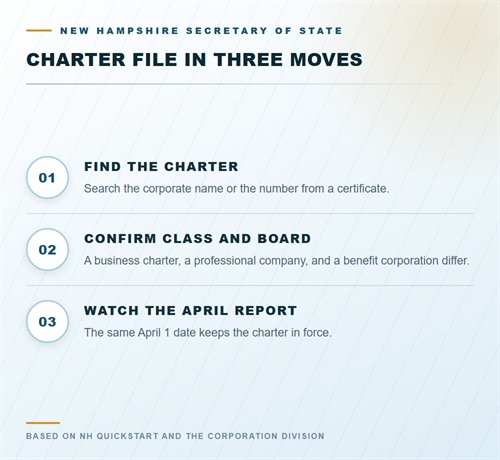
A New Hampshire corporation search starts with a name and finishes at a charter. The entry gives the legal name, the business ID, the incorporation date, the registered agent and office, the standing, and the documents on file. It says nothing about what the company produces, who holds its shares, or how it is financed, because the division records charters rather than commerce.
Charter, Bylaws and the Division’s Copy
The charter is the public paper and the bylaws are the private one. The division keeps the articles and every amendment to them, while the bylaws stay in the minute book at the company’s office. A reader who needs the internal rules must ask the corporation, and a private company may decline without giving a reason.
How Corporate Entries Are Sorted
Records are indexed by legal name as filed, so a business corporation, a professional corporation, and a benefit corporation sharing a name stem appear near one another in a result list. The type field separates them and the standing field narrows the set. The business ID is the only key that reaches one file without ambiguity.
New Hampshire corporate forms and fee page:
https://www.sos.nh.gov/forms-and-fees
Articles of Incorporation and Form 11
Form 11 brings an ordinary business corporation into being. It supplies the name, the registered agent and office, the purpose, the number and classes of shares the company may issue, and the name and address of each incorporator. The charter takes effect when the division accepts the paper, which can differ from the date the incorporators signed it.
Share Authority in the Charter
The articles state the ceiling on shares and the classes with their rights, and they may leave the board to settle the terms of a series inside a class. A figure in the charter is authority to issue rather than a count of shares sold. That difference matters when a buyer asks how far an existing holding can be diluted.
Professional Charters on Form 11PC
A professional corporation is chartered for a licensed service, and Form 11PC adds the professional purpose and the licensing particulars of the holders. Each holder must be licensed in the field, and one who loses a licence has to transfer the interest. The division keeps the charter and leaves discipline to the licensing board that granted it.
Settling the Class at the Outset
The class is fixed when the charter is accepted, and moving between classes later needs an amendment, so the choice deserves thought before the paper is sent. A company that expects outside investment may value the flexibility of a benefit charter or of a second class of shares. A charity seeking exemption files as a nonprofit instead.
Benefit Corporations and Their Report
A benefit corporation is a business corporation with a public benefit written into the charter, and its directors must weigh that benefit alongside return to holders. For filings, the division treats it as any other corporation, with one addition: a report on the benefit, filed each year. The paper is short and the office charges for it like other corporate documents.
The Stated Benefit
The charter names a material positive effect on society or the environment together with a third-party standard by which the company measures it. The purpose cannot be bargained away by a later board, and any change needs the approval the statute sets. A reader testing the claim should read the charter rather than a marketing page.
What the Benefit Report Covers
The report describes how the company pursued its stated benefit, which standard it applied, and where it fell short. It is a public paper, so a customer or an investor may ask for it directly. The division files it without judging whether the purpose declared in the charter was met.
Directors and the Two Duties
A benefit director reports on whether the company pursued its purpose during the year, and that assessment travels with the annual benefit report. The board still owes the ordinary duties of care and loyalty, and the public purpose sits beside them rather than replacing them. A reader who wants the reasoning should read the director’s statement.
Directors, Officers and Holders of Shares
The public record names no shareholders and no directors, except where a name happens to sit in the registered agent field. A corporation may raise money from hundreds of holders and still show nothing about them in the register. The silence is deliberate, and it applies to a family company and a listed one alike.
Where a Director’s Name Surfaces
A director’s name reaches the public file only through a signed document, such as an annual report that asks for the signer, or a court paper. The division keeps no roster of the board. A request for the present directors goes to the corporate secretary, and a public company answers through its filings with the securities regulator.
What Proves a Shareholding
A share certificate and the company’s stock ledger establish a holding, and neither is lodged with the state. A purchaser of a private company therefore leans on warranties in the sale contract and on the ledger handed over at closing. A register search confirms the corporation, not the distribution of its shares.
Officers in the Filing Record
An officer’s name may appear as the signer of a report or an amendment, and that shows who acted for the company on a given day rather than who governs it. A treasurer who signs one paper and leaves the next year leaves no further trace. Treat each name as a dated event, not a standing appointment.
The April Report for Corporations
A corporation reports every year by April 1, and the report keeps the charter in force. It restates the accepting party, the registered office, and the mailing point, which keeps the next notice on a live address. A company that files after the date pays a late charge, and a long silence can cost it the charter altogether.
What the Report Repeats
The form repeats the registered particulars and asks for the signer’s name and title. A move during the year belongs on Form 10 as well, because the report confirms an appointment instead of making a new one. The portal stores the confirmation, and that record settles a later disagreement about the filing date.
Administrative Dissolution
A corporation that ignores the report for long enough is dissolved by the division, and the entry shows the closure with a date. Its contracts do not disappear, but the capacity to sue on them becomes awkward while the charter is dead. A director who learns of the closure late should act before a counterparty raises it.
Bringing the Charter Back
Restoration asks for the missing reports and the charges attached to them, and the division then returns the company to the active list. The document list keeps the dissolution and the return as separate events. A bank reading the file sees both, and a short gap reads better than a long one.
Amendments, Restatements and Corrections
Form 14 amends a single charter term, Form 15 restates the charter in full, and a correction paper repairs a clerical fault in something already accepted. The board normally approves an amendment, and the holders vote where the statute or the charter demands it. The division reads the paper for form and does not weigh the vote behind it.
Form 14 in Use
The subjects that arrive most often are the corporate name, the share authority, the registered agent, and the purpose clause. A name change needs a check that the new string is free, since the company name records will not carry two live companies under one name. The amendment then states the term as it will read afterwards.
When a Restatement Pays
A restatement earns its place once several amendments have left the charter hard to follow, because it hands one clean text to a lender or a purchaser. It replaces the charter as filed, and the older papers remain in the list as history. A reader wanting current terms should open the latest restatement first.
Correcting an Accepted Paper
A correction addresses a misspelling, a wrong date, or a mistaken cross-reference in a document the division already accepted. It does not alter a decision, and a company seeking a different term files an amendment instead. Both versions stay on file, so a reader can see exactly what was repaired.
Mergers and Other Combinations
A merger places two or more corporations under one survivor, and the survivor takes the assets and the liabilities of the rest. The board of each company approves a plan, and the holders vote wherever the statute requires it. The filing itself is brief, and the division records the survivor without reading the plan behind it.
Approval and the Share Vote
The charter and the statute together decide whether a simple majority or a larger figure carries the plan, and a company with several classes may need a separate vote of each. A holder who objects may hold appraisal rights, and those rights run through the courts rather than the division.
Papers the Division Expects
The office wants articles of merger signed by each company, giving the names, the survivor, and the effective date. Absorbed entries are marked as merged and stay in the index. A creditor seeking an absorbed company should address the survivor, which holds the records and carries the duties.
Dissolution and Its Reversal
Form 19 ends a corporation, and the board and the holders approve it before the paper reaches Concord. The filing states that debts are paid or provided for and that what remains has gone to the holders. A dissolution sent before the affairs are settled can expose a director to a later claim.
Winding Up Before the Paper
The company collects what it is owed, sells what it will not keep, pays its creditors, and distributes only what is left. The certificate goes to the division after that work, not before it. A director who distributes early may have to return the amount, and the register will never show that dispute.
Revoking a Dissolution
A company that filed too soon, or found reason to continue, may revoke the dissolution inside the window the statute allows. The paper repeats the charter particulars and states the revocation. The entry then shows the dissolution and the revocation in sequence, which a lender reads as a single episode in the file.
The Final Report
A closing corporation files its last annual report and then the dissolution, and the two dates usually sit close together. The books remain with the company as long as the statute demands, and a court can compel them afterward. The division holds the charter and the filing history, not the accounts.
Foreign Corporations Registered in the State
A corporation chartered elsewhere that does business in New Hampshire applies for a certificate of authority on Form 40. The form names the home jurisdiction, the name used there, the local agent and office, and the officers and directors it asks for. It also carries a certificate from the home office showing the company stands there.
Amended Authority and Withdrawal
A change of corporate name, home state, or New Hampshire agent goes on an amended authority. A company that leaves the state files a withdrawal, which ends the registration without dissolving the corporation at home. Both papers keep the entry accurate, and comparing dates shows the sequence of events.
The Foreign Registered Name
A foreign corporation whose name is already taken here may register an assumed name for local use on Form 5, and the registration runs for a fixed term before renewal. The name belongs to the registration rather than to the corporation. A lapse leaves the company trading under a name the state no longer records.
The Home-State Certificate
The application needs a recent certificate from the home office confirming that the corporation exists there. A home jurisdiction that has dissolved the company stops the local registration until the company is restored. The certificate travels with the form rather than staying with the applicant.
Certificates, Copies and Added Handling
A certificate of good standing states the corporate condition on the day it is issued, and a bank or a foreign registry usually wants one dated within a few months. A certified copy reproduces a charter or an amendment with the seal attached. Both come from the division, and both may be requested online through the portal.
What the Certificate States
The paper confirms that the corporation exists, that a charter sits on file, and that reports are current. It says nothing about shares, directors, profit, or litigation, and a recipient needing those must ask elsewhere. The issue date is the part a careful reader checks before anything else.
Expedited Handling
The division moves a filing ahead of the queue for an added charge, and the request must be made when the paper is sent. A formation, an amendment, a merger, or a certificate can be handled this way. The extra amount appears on the same payment as the filing charge.
Corporate Filing Charges
The schedule below covers the papers a corporation is most likely to send or order. An electronic payment carries a handling charge under RSA 5:10-a, so the online column shows the paper amount with that charge added. A filing sent by post carries the listed amount alone.
| New Hampshire corporation item | Paper | Online |
|---|---|---|
| Articles of incorporation, Form 11 | $100 | $102 |
| Professional articles, Form 11PC | $100 | $102 |
| Articles of amendment, Form 14 | $35 | $37 |
| Restated articles, Form 15 | $35 | $37 |
| Articles of dissolution, Form 19 | $35 | $37 |
| Revocation of dissolution | $35 | $37 |
| Articles of merger | $35 | $37 |
| Articles of correction | $35 | $37 |
| Copy of a filing, per page | $1 | $1 |
| Certification of a copy | $5 | $5 |
| Good standing certificate | $5 | $7 |
| Expedited service | $25 | $27 |
Frequently Asked Questions
The questions below arise from charter work and from checks run on a company before a contract is signed. Each answer names the form or the office that decides the question, and a reader holding a filing should confirm the current schedule at the counter.
Does the register show who owns a corporation?
No. Holders of shares and directors stay off the public file, and the charter shows share authority rather than holders. A purchaser obtains the stock ledger from the company, and the division holds the charter and its amendments.
How does a benefit corporation differ?
Its charter states a public benefit and a standard for measuring it, and its directors weigh that benefit beside return to holders. It files the same annual report and adds a report on the benefit each year.
Can a corporation be chartered in two states?
A corporation holds one home charter. To trade in New Hampshire it registers a foreign certificate of authority, and that registration sits beside the home charter rather than replacing it.
What brings a corporate registration to an end?
A voluntary dissolution filed by the company, or an administrative dissolution ordered by the division after reports go unfiled. Both carry a date, and a dissolution may be revoked inside the statutory window.
Are bylaws filed with the state?
No. The articles go to the division while the bylaws stay with the company itself. A holder who wants to read them asks the corporate secretary rather than the registry, and a private company may refuse.
What does an amended authority cover?
The foreign corporation reports a new corporate name, home jurisdiction, agent, or office on the amended authority, and the register keeps that paper beside the original authority.