
Every New Hampshire business leaves a paper trail with the Secretary of State, and most of that trail is open to anyone who asks. Articles, annual reports, agent statements, and merger filings all land in the Corporation Division, where they are indexed by entity number and preserved for public inspection. The file is thinner than a company’s own minute book, yet it usually settles the basic questions.
What arrives on request depends on the document. Some items read free on screen, others carry a certification charge, and a few sit outside the division’s custody altogether. The sections below sort a file into its parts, note which charges apply, and describe how to obtain copies that satisfy a bank, a court, or a registrar in another state.
What the Records File Contains
A profile page from a New Hampshire business records search lists the entity name, its identification number, formation date, status, principal office, and registered agent. Beneath that summary sits a document index, one line per filing, each with a date and a document number. The index is the map of the file: open a line and you reach the underlying pages, which you can read in the order they were accepted. A reader who wants the person behind the address can follow the New Hampshire registered agent search page.
What the Index Lines Represent
Each line corresponds to one accepted submission rather than one event. An amendment filed twice after a rejection appears once, under the date it was finally taken in. Gaps between formation and the first annual report often mean the company sat idle for a season, or that a prior filing was returned and never corrected.
Fields Worth Checking First
Status tells you whether the entity is current, delinquent, or dissolved. The principal office shows where management actually sits, which may differ from the mailing address on the website. Registration dates reveal how old the business really is, useful when a marketing page claims a decade of history but the file opened last spring.
Following Cross-References
Merged entities point to survivors; converted entities point to the new form. Those references are easy to miss and often account for why a name search returns two records with nearly identical addresses. Open both profiles before deciding which one carries the obligations you are chasing, since the older shell may still hold liabilities.
New Hampshire business filing help:
https://www.sos.nh.gov/corporations-0/business-faqs
The Charter Documents and What They Establish
Articles of incorporation or articles of organization begin the file. They name the entity, state its purpose, identify the initial agent, and fix the share structure for corporations. Later amendments appear as separate entries. Read together, these pages show the legal frame of the business as it stood on each filing date, not as it stands today.
Reading the Purpose Clause
New Hampshire filings often use a broad purpose statement rather than a narrow one. A generic clause does not mean the company may do anything without limit, since regulated activities still require separate licenses from the state or a municipality. Compare the stated purpose with what the business advertises, and note any gap between the two.
Amendments That Change the Frame
A name change, a share increase, or a conversion each produces its own document. Reading amendments in sequence shows how the entity evolved, and it exposes restructurings that never reached a press release. For due diligence, the amendment set often matters more than the original articles, because it captures the decisions made after launch.
Restated Articles and Their Use
A restatement replaces the charter in one document, folding prior amendments into a clean text. When a restatement exists, read it first, then check the index for anything filed afterward. Filings dated after the restatement control the current picture, and the earlier pages become background rather than operative authority.
Annual Reports as a Running Record
Each year by April 1 the entity files a report naming current officers, directors, and the agent, and confirming the principal office. A fixed fee applies, with a surcharge once the deadline passes. Read in sequence, the reports trace changes in control that never produced a separate amendment or a public announcement of any kind.
Officers Named Year by Year
Comparing consecutive reports is the cheapest way to spot a management change. A new president appearing in one year and gone the next may signal a sale, a dispute, or a short-lived arrangement. The reports do not give reasons; they record only who signed, and that alone can redirect a line of inquiry.
Late Filings and Their Meaning
A missing report, or one filed months past the deadline, hints at administrative trouble. Reinstatement after dissolution produces a burst of catch-up filings in a single month. Read those dates alongside the status field before concluding that a business is healthy, since a current status can hide a long stretch of neglect.
What the Report Does Not Include
Revenue, headcount, and ownership percentages never appear. The form asks for names and addresses, not financial detail, so a report filed without change can hide a serious shift in the business. Where those numbers matter, request the company’s own statements or its tax returns under a confidentiality agreement.
Viewing and Downloading Without Charge
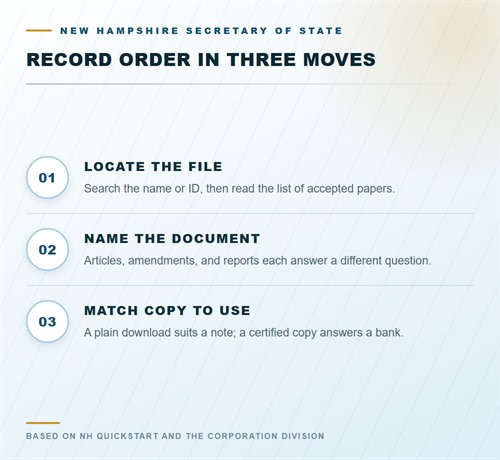
Charter documents and annual reports can be opened and saved from NH QuickStart at no cost. The portal serves the same images the division holds, which spares a trip to Concord. A download is a plain copy, though: it carries no seal and no signature authentication, and that gap matters when a third party demands proof rather than convenience.
Reading a Scanned Image
Older filings arrive as microfilm scans, sometimes faint or rotated a quarter turn. Zoom in on the signature block and the filing stamp, since those carry the date and the clerk’s mark. If a page is illegible, request a clearer reproduction instead of guessing at what the original said or who signed it.
Saving a Copy That Holds Up
A download is fine for internal review, negotiation, and your own files. Once a document must satisfy a bank’s counsel or a foreign registrar, the plain image usually fails the test. Plan the certified order early enough that a mailing delay will not derail a closing or a licensing deadline.
Ordering Certified Copies
Certification adds the state’s attestation that a copy matches the file. The charge combines a flat certification amount with a per-page amount, and an expedited request carries its own surcharge. Orders are placed by telephone or by email to corporate@sos.nh.gov, since the portal does not complete certified orders on its own.
| Item | Paper | Online |
|---|---|---|
| Certified copy — base certification charge | $5 | Not offered |
| Certified copy — each page reproduced | $1 | Not offered |
| Expedited handling on a copy order | $25 | Not offered |
| Certificate of good standing | $5 | $5 |
Counting the Pages Before You Order
Cost tracks length, so a long charter with exhibits can add up faster than expected. Ask staff for a page estimate before the order is pulled, then decide whether you need the exhibits or only the operative articles. Ordering a full restatement when three pages will do is avoidable expense.
Turnaround and Delivery
Standard orders move through the same queue as other correspondence. Expedited handling buys position in that queue rather than a guaranteed clock, so reserve it for genuine deadlines. Certified pages arrive by mail unless you arrange pickup in Concord, and the envelope should be tracked if a filing date depends on it.
When a Plain Copy Will Do
Internal memos, negotiation drafts, and background research rarely need a seal. Save the certification charge for the items a third party will actually inspect: charter pages for a bank, a good standing certificate for a registrar, an annual report for a litigation exhibit. Everything else can stay as a download.
Certificates of Good Standing and Their Uses
The certificate confirms that an entity exists and has met its filing obligations as of a stated date. Lenders request it before closing a loan, and out-of-state registrations often demand one issued recently. The charge is modest, and the request can be made through the portal or in writing to the division.
What the Certificate Does Not Promise
It speaks to filing compliance, not solvency, licensing, or tax standing. A company can hold a current certificate and still owe the state unemployment fund or a city permit fee. Read the document for exactly what it certifies, then verify the other items through their own agencies before releasing funds.
Timing the Request
Many recipients insist on a certificate dated within a set window, often ninety days. Ordering too early wastes the charge; ordering too late stalls a closing. Work backward from the deadline, and add several days if the original must travel by post to a bank or a secretary of state.
Closed and Dissolved Files
Entities that dissolve or are administratively revoked keep their records. The profile changes status and the index stops growing, but the historic pages remain viewable. Old files help when tracing a predecessor, settling a claim against former owners, or proving that a similarly named company is unrelated to the one you are checking.
Revocation Compared With Voluntary Dissolution
Revocation follows a missed report or a lapsed agent, and it can be reversed through reinstatement. Voluntary dissolution is a deliberate filing that winds the business down. The status line distinguishes the two, and the difference shapes whether the entity can be revived at all or must begin again as a new company.
Claims Against Closed Businesses
A dissolved company may still be sued within limits set by statute, and former owners can face claims in some circumstances. The historic file identifies who ran the business and when, which is exactly what a plaintiff needs to serve papers. Pull the last few annual reports before the closing entries.
Tracing a Predecessor
Merger documents name the survivor; conversion filings name the successor form. Where a name was reused by an unrelated venture years later, only identification numbers separate the two histories. Check formation dates and agent names before assuming continuity, because a shared name is the weakest possible link between records.
Reviving a Closed Entity
Reinstatement is available for some revoked companies and usually requires the missing reports plus the unpaid charges. The revived entity keeps its original identification number and formation date, which preserves contracts that name it. A voluntary dissolution is harder to undo, and a fresh filing may be the only route.
Filings Held Somewhere Other Than the Division
UCC financing statements sit in a separate index, and searching them answers a different question than a corporate file does. Municipal licenses, property deeds, and court judgments live with the city, county, or court that created them. Trade names are filed with the Secretary of State under their own numbering, apart from the entity series.
Liens and Secured Debt
A corporate profile will not disclose borrowing. Financing statements name the debtor, the secured party, and the collateral, and they are the place to look when a purchase or loan is contemplated. Blanket liens covering all assets deserve particular attention before any acquisition, since they can follow the business into new hands.
Local Licenses and Permits
Cities and towns issue business licenses, food permits, and sign approvals. Those records sit at the municipal office rather than in Concord, and they often reveal a physical location the state file omits. A restaurant with a clean state profile may still face local code problems that never reach the corporate index.
Court Files and Judgments
Superior and district courts hold complaints, judgments, and small claims. A judgment against a business may appear there long before it affects corporate status, and a satisfied judgment can linger in commercial databases for years. Read the docket itself rather than a summary service that may have missed a dismissal.
Matching a Name to the Right File
Names repeat across entity types and across decades. Confirm the identification number before ordering anything, and compare the formation date and principal office against what your counterparty supplied. A certified copy of the wrong company is a costly error, since charges are not refunded once the pages are pulled from storage.
Similar Names in Different Forms
A corporation and a limited liability company can carry nearly identical names, and a trade name may echo both. Each sits in its own series with its own number. Search the base phrase rather than the full string, then sort the results by formation date to see which one is oldest.
When Nothing Matches
A blank result can mean the business is registered elsewhere, operates under a different legal name, or never filed at all. Ask the owner for the identification number and the state of formation. Failing that, check the trade name index before concluding that the company is unregistered or has disappeared.
How Long the Division Retains Material
Records for dissolved entities are kept indefinitely in most cases, though very old microfilmed images may need staff help to retrieve. Requests for pre-digital material take longer than portal downloads. When a deadline is tight, the expedited option exists for exactly this situation, at the surcharge shown above.
Why Old Images Take Longer
Microfilm and early digital scans are stored off the live system, so a clerk must locate and reproduce them by hand. Nothing is lost, but the work is manual and queues behind current filings. Build extra days into any research plan that reaches back before the portal era began.
Records That Were Never Created
Some details never entered a filing: internal ownership percentages, private side agreements, and board minutes stay with the company. The state file is a public skeleton, not a full corporate book. Expect to request the rest from the business itself, and treat any refusal as a signal worth weighing.
Related Searches Worth Running Alongside
A corporate file rarely tells the whole story. Pair it with a UCC lien search to see secured debt, and check name availability records when a new entity is planned. Neither query replaces the corporate file; each answers a question the file cannot, and together they sketch a fuller picture.
Building a Research Sequence
Start with the profile, confirm identity, then pull the charter and the latest annual report. Add liens next, then local licenses if a physical site matters. Keep a note of every document number you consult so a colleague can retrace the path without repeating the work or duplicating an order. Delivery happens inside the portal account that placed the order.
Frequently Asked Questions
Questions about this file usually turn on what a document proves, what a copy costs, and how quickly an order returns. The answers below cover the points that arise when a buyer, a lender, or a lawyer needs a paper from the Corporation Division.
Are New Hampshire business filings free to view?
Charter documents and annual reports can be viewed and downloaded at no charge through NH QuickStart. Certified copies, good standing certificates, and expedited handling carry charges, and those items are ordered separately from the portal download.
How much does a certified copy cost?
The total combines a flat certification charge with a per-page amount, and expedited service adds a surcharge. Because the cost depends on length, ask for a page estimate before the order is pulled from the file.
Can I get a certificate of good standing online?
Yes, the certificate can be requested through the portal for a flat charge. It confirms the entity’s existence and filing compliance as of the issue date, and lenders typically want one dated within ninety days.
Where do I find records for a company that closed?
Dissolved and revoked entities stay in the index with their historic pages intact. Search the name, open the profile, and review the document list; the filings remain available even though the status line shows the business is inactive.
Does the state hold UCC filings in the same system?
No. Financing statements are indexed separately from corporate documents, so a lien check needs its own query. A corporate profile will not reveal secured debt recorded against the business or its equipment.
Can I order copies by mail instead of online?
Written requests are accepted by the Corporation Division at 25 Capitol Street in Concord, and email to corporate@sos.nh.gov works too. Include the entity number and the exact documents wanted so staff can price the order correctly.