

A registered agent is the party that accepts legal papers on behalf of a New Hampshire company. The name and street address appear in the state filing system, and anyone checking a business can read that field within seconds. Knowing what the entry means, and who may lawfully fill it, makes a filing record far easier to weigh.
The Corporation Division of the New Hampshire Secretary of State maintains this detail for every active entity, from a two-owner limited liability company to a bank with branches statewide. The notes below cover where the field sits in a file, the residency rule, the handling of address changes, and what happens when a company needs a different agent partway through a year.
Where the Registered Agent Field Appears
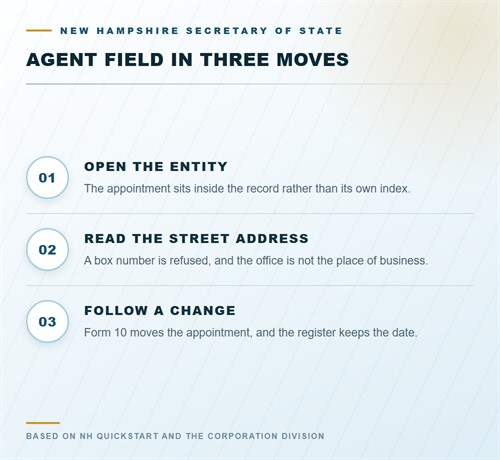
Open any entity profile from a New Hampshire company search and the agent appears near the top, just under the business name, the identification number, and the formation date. The record names one party and gives a street address, sometimes with a separate mailing address. The office must be a real location where documents can be handed over in person. The New Hampshire business records page covers the papers that arrive at that address.
Reading the Address Line
The address is not decorative. It marks where a deputy sheriff, a constable, or a private process server may appear with a complaint. When the line shows a suite, delivery happens at that desk. When it shows only a building, the recipient is whoever stands behind the front counter for the tenant.
What the Field Does Not Show
The entry says nothing about ownership, licensing, or financial health. An agent may be a stranger hired for the role, holding no stake in the business at all. Treat the name as a delivery contact, then look to the officers and the principal office for the people who actually run the company.
Agent Compared With Principal Office
Two addresses usually sit side by side on a profile, and they serve different purposes. The principal office is where management operates; the registered office is where legal papers land. They often coincide for a small firm and diverge sharply for one that keeps a lawyer or a filing service on retainer.
New Hampshire registered agent rules:
https://www.sos.nh.gov/registered-agents
Who Is Eligible to Serve as Agent
Two categories qualify. A natural person must actually live in New Hampshire, and the state expects a genuine residence rather than a mail drop. A company may serve only if it holds a physical street address inside the state and is authorized to conduct business there. One party may act for many entities at once.
Resident Individuals
Any adult living in the state can take the post, including an owner, a family member, or a lawyer. No license or registration is required for the individual role. The real qualifications are a stable address, a willingness to be found during business hours, and enough care to pass papers along without delay.
Qualified Business Entities
A corporation or limited liability company may hold the appointment when it is registered to do business in New Hampshire and keeps an actual office there. Out-of-state firms qualify once they obtain authority. The entity’s own street address, not a box number, becomes the delivery point shown in the public record.
Agents Who Hold Many Appointments
Nothing caps the number of companies one agent may represent. Filing services appear on thousands of profiles, which is why their names carry little evidentiary weight. A resident who acts for a neighbor’s company and their own makes a far more distinctive mark on an index than a Concord registered agent company.
Verifying a Candidate Before Appointment
Check that the proposed address exists on a map, that the street number matches a real building, and that someone there will accept a hand delivery. For an entity, confirm its authority to do business in the state through its own profile. A five-minute check prevents a rejected filing weeks later.
Commercial Agent Services Compared With Acting In-House
A commercial provider charges an annual retainer and supplies a permanent address in a city such as Concord or Manchester, along with staff who scan incoming mail the same day. An owner who acts personally saves that retainer but takes on the duty of being reachable. Owners who travel often prefer the paid arrangement.
When a Paid Service Makes Sense
Companies with several owners, frequent litigation exposure, or a habit of relocating benefit most from a firm. The service absorbs address churn, keeps a dated log of every delivery, and forwards scanned pages by email. That log becomes useful evidence if a dispute later turns on whether notice arrived.
What In-House Arrangements Require
Self-appointment works for a small, settled business with one address and predictable hours. It demands discipline: a clerk who knows what to do with a summons, a routine for logging the date, and a plan for vacations and illness. A missed delivery can default a case before the owners learn it exists.
Mixing the Two Approaches
Some firms use a commercial agent for the legal address while an owner handles daily correspondence. Others reverse it, naming an officer for the state filing and renting a separate mail service. Either blend is permitted, so long as the address on file can accept personal delivery during ordinary business hours.
The Street Address Rule and Why Post Office Boxes Fail
A post office box cannot be listed. The state insists on a physical location because a server must be able to walk in and place documents in a hand. A suite inside an office building satisfies the rule. Using a box, or a virtual mailbox without a staffed desk, invites rejection at review.
Suite and Co-Working Addresses
Shared office floors and co-working sites usually pass, provided someone at reception accepts deliveries and can confirm the tenant. A bare mailbox inside such a building does not. Filings have been returned when an examiner concluded the address could not receive personal service during normal hours.
Consequences at Review
A rejected statement leaves the old agent in place, so the company believes it made a change that never took effect. Rejection notices arrive by mail or email and can sit unread. Confirm the update appears on the profile before assuming it is complete, especially when a move ties to a closing date.
How a Company Changes Its Agent or Registered Office
Form 10 carries both changes, whether the agent is replaced, the office shifts, or the two occur together. The filing is a statement submitted to the Corporation Division rather than an amendment to the charter. It takes effect when the division accepts it, so the incoming party should agree before the form leaves your desk.
The Consent Requirement
The incoming agent must accept the appointment, and the acceptance should be documented at the time of filing. Most forms include a signed consent line, and examiners may return a package that lacks one. For a commercial service, consent usually arrives inside the engagement letter, which the company keeps with its formation documents.
Timing and Effective Date
File the statement before the move, not after. A gap between vacating an office and recording the new one leaves the company exposed if a complaint arrives in between. Electronic submissions sent through the QuickStart search portal usually post within a few business days, while mailed forms wait in the intake queue.
One Filing, Several Changes
A single statement can swap the agent, shift the office, and correct a misspelled street name at the same time. Splitting those corrections across separate submissions invites confusion in the index. Describe every change on the one form so the record moves in a single pass.
Cost of Filing the Change
Paper submissions cost less than electronic ones, a reversal of the pattern seen in many states, because the online channel adds a handling charge. The table below gives both figures. Nothing else is owed at filing time, and no annual report is due alongside the statement.
| Item | Paper | Online |
|---|---|---|
| Change of registered agent or registered office (Form 10) | $15 | $17 |
Why the Portal Adds a Handling Charge
The added amount covers card processing and the convenience of an immediate receipt. Companies that file several statements a year sometimes send one paper package to avoid repeated handling charges. Both routes produce the same public record once the division finishes review and posts the change.
Keeping Proof of Payment
Save the confirmation page or the cancelled check with the company’s minute book. A dispute over whether a change was filed on time sometimes turns on a payment record rather than the profile itself, since the index updates after processing. A dated receipt settles the question faster than a support request.
Resignation and What Follows It
An agent who wishes to withdraw files a statement of resignation with the division and notifies the company. Resignation does not take effect at once; a waiting period gives owners room to appoint someone else. If no replacement is named, the entity drifts toward administrative dissolution.
The Waiting Period
The delay protects the business from vanishing notice. During that window the outgoing agent still passes along anything received, and the company can file a replacement without a break in coverage. Owners who ignore the notice discover the problem only when a default judgment appears on the docket.
Gaps That Endanger Standing
Once a resignation matures with no successor on file, the division may treat the entity as delinquent. Reinstatement is possible but costs time and money, and a lapsed status can stall a loan or void a contract. The remedy is simple: keep the agent field current at all times.
Service of Process and the Agent’s Core Duty
When a lawsuit, subpoena, or state notice arrives, delivery goes to the agent at the registered office. That handoff legally completes service on the business, whether or not the owners personally read the pages. The agent’s task is to forward everything promptly, since delay does not undo service.
What Counts as Valid Delivery
Personal delivery to the named party, or to a person of suitable age at the office, generally suffices. Mailing may be allowed in some proceedings when the rules say so. Because standards differ by court, the agent should record exactly how and when each item arrived.
Forwarding and Deadlines
Answer deadlines run from the date of service, not the date an owner opens the envelope. A week lost in transit can consume most of the response window. Good practice is to scan the papers the same day, email them to every officer, and send originals by a tracked method.
Records of What Was Received
Keep a simple log: date, sender, method of delivery, and the person notified. If service is later contested, that log supports the company’s account of when it learned of the claim. Few small businesses keep such a record, and the ones that do recover faster when a case begins badly.
Keeping the Agent’s Own Address Private
Because the agent’s street address is published, anyone using a home as the registered office exposes that address to public view. Owners who prefer discretion hire a service, which places a commercial address in the record instead. The trade is a modest annual cost against the loss of a home address to scrapers.
Scraping and Mail Lists
Public filings are harvested continuously by data brokers, who resell addresses to marketers and, occasionally, to people with worse intentions. A residence listed as a registered office tends to attract solicitation mail addressed to the company. A commercial address absorbs that flow and keeps the household out of it.
Weighing the Cost
Privacy has a price, and for a one-owner firm it may not be worth paying. Consider how visible the address already is through property records before deciding. Where a home is already public, the agent field adds little exposure, and self-appointment remains a reasonable choice.
Reading Agent Names Across Related Companies
Large agent firms appear thousands of times in the state index, so a familiar name is weak evidence of shared ownership. A small agent name, especially an individual, more often points to a genuine connection. Pairing the agent with the officers on the profile gives a clearer picture of control.
Shared Agents and Shared Control
When five companies share one obscure agent and one president, the pattern deserves attention. It may signal a family group, a franchise arrangement, or a series of shells. None of those conclusions is safe from the agent name alone, but the overlap justifies a closer look at officers and addresses.
Following the Chain to Officers
Cross-check each entity’s listed officers and principal office against the others. Repeat addresses, repeated signatures, and formation dates clustered in one month all carry more weight than a shared agent. Build the picture from several fields before drawing a conclusion about who stands behind a business.
Where the Index Falls Short
The public file does not list every person who influences a company. Silent investors, lenders with covenants, and family members holding shares through a trust rarely surface. Treat the agent and officer fields as the visible layer, then use court records and lien filings to probe what sits beneath them.
Records Held by the Division and Where They Sit
The division stores the current agent on the live profile and keeps superseded versions in the entity’s filing history. Older statements surface when you pull the document list for the company. For a question about chain of custody, that history matters as much as the present entry does.
Historic Statements
Each accepted Form 10 adds a line to the index, so a limited liability company that moved three times shows three entries. Reading them in order reveals when a professional firm took over, or when an owner withdrew from the role. Dates on the index usually track the effective date of each change.
Requesting Authenticated Copies
Plain downloads come from NH QuickStart at no charge. A certified version, needed for litigation or a foreign registration, comes from the division corporate mailbox (corporate@sos.nh.gov) or a telephone request, and the division sets the fee. Certified pages carry a seal and signature that plain copies lack. The portal that holds the appointment lays out each screen of that order in sequence.
Frequently Asked Questions
Readers arrive with questions about eligibility, the street address rule, and the paperwork that moves an appointment. The answers below cover the points that come up most often when a company changes agent or when a counterparty reads that field on a record.
Can a company act as its own registered agent in New Hampshire?
Yes, an entity may serve, provided it holds a physical street address in the state and is authorized to transact business there. Many small companies instead name a resident owner, which involves less paperwork and no annual retainer.
How much does it cost to change the registered agent?
The cost depends on the channel. Paper filing is cheaper than the electronic route, which adds a handling charge. No annual report payment accompanies the change, and no newspaper publication is required afterward.
Does the new agent have to consent?
Yes. The incoming party must accept the appointment, and most packages include a signed consent. The division may return a statement that arrives without one, which leaves the previous agent in place.
What happens if an agent moves without telling the state?
The record goes stale and service may be attempted at an address nobody monitors. A company that misses the papers can lose a case by default, so the office change should be filed as soon as the move occurs.
Is the agent’s home address visible to the public?
Yes. Whatever street address is filed becomes part of the public profile. Owners who want a residence withheld typically retain a commercial agent and use that firm’s address in the record instead.
Can one person serve as agent for several businesses?
Nothing limits how many appointments a resident or qualified entity may hold. Professional services routinely act for hundreds of companies, and the state treats each appointment as a separate filing obligation with its own consent.